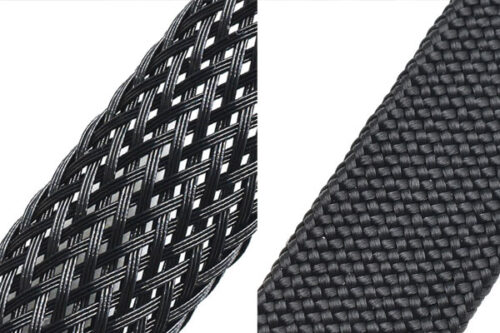
In modern industrial systems, cables serve as critical carriers for power and data transmission, directly influencing the stability and safety of entire operations. However, industrial environments vary significantly in working conditions, equipment structures, and safety standards. This leads to highly diversified performance requirements for cable protection materials.
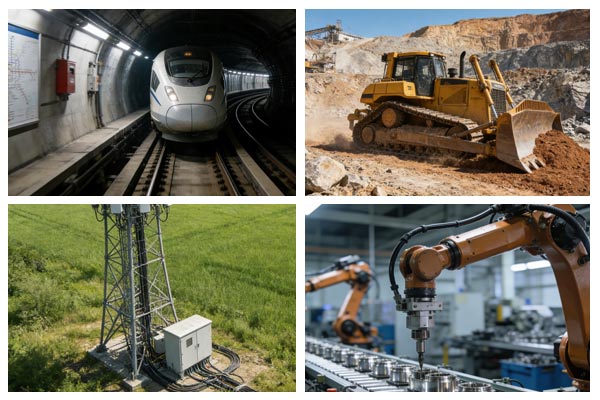
1.Why do high-temperature industries require extreme heat resistance and anti-carbonization properties? (Metallurgy, Glass, Foundry)
High-temperature industries expose cables to continuous heat radiation ranging from 200°C to 800°C. Under such conditions, conventional cable protection materials quickly soften, degrade, or carbonize, leading to short circuits, insulation failure, and even fire hazards. This makes it essential to use cable protection materials specifically engineered for thermal stability, such as:
- silicone rubber, fluororubber, or ceramic-based silicone insulation
- fiberglass braids or ceramic fiber outer sleeves
- fire-resistant and anti-splatter protective structures
The fundamental reason behind these requirements is simple: in extreme heat and thermal shock, the physical stability of the cable protection system determines whether the equipment can operate safely.
2. Why do chemical and oil & gas industries emphasize corrosion resistance, oil resistance, and chemical durability?
Chemical plants, power plants, and oil fields expose cables to:
- acidic or alkaline vapors
- organic solvents
- oils and lubricants
- corrosive liquid splashes
PVC and standard plastics break down rapidly under these conditions—they become brittle, swell, dissolve, or crack. Therefore, protective cable materials must include:
- TPU (oil- and abrasion-resistant)
- TPEE (chemical-resistant)
- fluoropolymers such as FEP or PFA
These selections are driven by one key reality: chemical erosion often progresses faster than mechanical wear. Thus, cable protection materials must have molecular structures capable of resisting long-term chemical exposure.
3.Why do robotics and automation industries require flexibility, bend resistance, and fatigue performance?
In robotics and automation, cables undergo:
- high-frequency bending (10+ million cycles)
- torsion (±360° motions)
- repeated lifting or high-speed drag chain movement
Standard cable sleeves crack after only tens of thousands of cycles. As a result, cable protection materials for robotics must include:
- high-flexibility TPU
- ultra-soft TPE
- reinforced fiber braids or engineered flexible structures
Here, the critical factor is that the service life of robotic cables is determined primarily by mechanical fatigue—not temperature or chemical exposure—making flexible cable protection solutions indispensable.
4. Why do outdoor industries (rail transit, photovoltaics, marine) require UV resistance, hydrolysis resistance, and salt-spray durability?
Outdoor environments introduce long-term risks such as:
- ultraviolet degradation causing polymer chain breakage
- moisture-induced hydrolysis weakening material structure
- salt-spray corrosion in marine and port applications
To address these challenges, engineers rely on outdoor-grade cable protection materials such as:
- UV-resistant black PE
- weather-resistant TPU/TPE
- fluoropolymers with superior UV and moisture resistance
The core reason: outdoor aging is cumulative and long-term, often spanning years or decades. The durability of cable protection systems directly defines the lifecycle cost of the entire installation.
5. Why Do Mining, Tunneling, and Construction Industries Prioritize Abrasion Resistance, Compression Resistance, and Flame Retardancy?
Harsh heavy-industry environments involve:
- continuous mechanical friction and dragging
- the possibility of heavy loads crushing cables
- high dust and humidity levels
Therefore, these sectors depend on cable protection materials that offer:
- exceptional abrasion resistance (TPU > PVC > PE)
- high mechanical strength and cut resistance
- LSZH (low smoke, zero halogen) flame-retardant properties
The underlying reason is straightforward: in these environments, most cable damage originates from mechanical forces—far more than heat or chemicals—making mechanical robustness the top priority.