
leave a message
If you are interested in our products and want to know more details,please leave a message here,we will reply you as soon as we can.


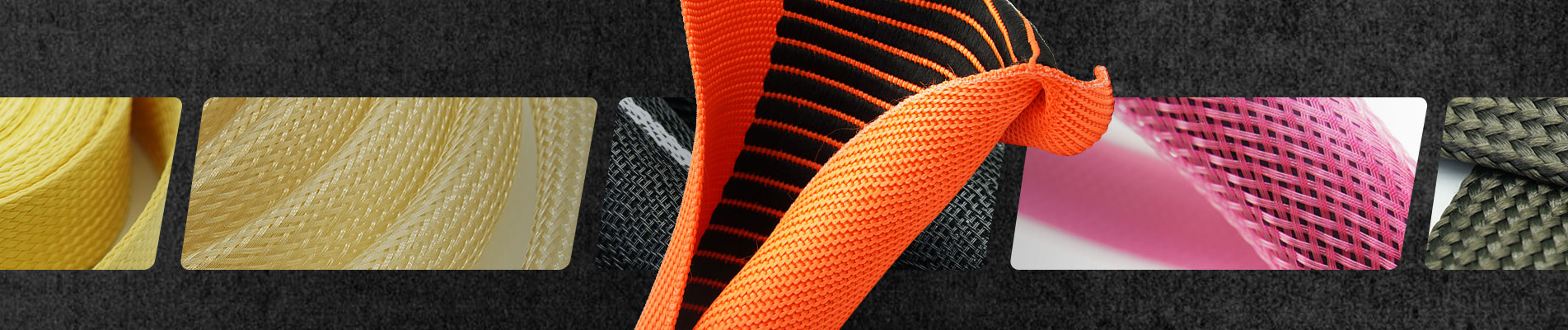
Selecting, comparing and optimizing materials for reliable cable protection solutions
Cable protection materials should not be selected by temperature rating or price alone. The finished product's structure, installed diameter, wall thickness, coverage, movement, environment and applicable test method can all influence actual performance.
MJ FLEX evaluates these factors together. Our objective is to help customers choose a technically appropriate solution that can also be manufactured consistently, documented clearly and supplied at the required scale.
Our material portfolio supports standard, high-temperature, high-strength, electrical-insulation and shielding applications.
Depending on the product and project, materials may include:
| MATERIAL GROUP | EXAMPLES |
|---|---|
| Engineering polymers | PET, PA6, PA66, PPS, PEEK, PE, PP and ABS |
| Fluoropolymers | PFA, PTFE, PVDF and related high-performance materials |
| High-strength fibers | UHMWPE, aramid fibers, Nomex® and Kevlar® |
| Inorganic fibers | Fiberglass and basalt fiber |
| Metals | Stainless steel, copper, tinned copper and plated copper wire |
| Functional systems | Silicone coatings, laminated structures and hybrid textile-metal constructions |
| 01 |
Material Selection |
Material selection begins with the application—not with a material name. Our team reviews the required protection function, installation method, service environment, compliance requirements and commercial constraints before recommending a material family.
| SELECTION FACTOR | WHAT WE REVIEW |
|---|---|
| Mechanical exposure | Abrasion, impact, vibration, tensile load, burst containment and repeated flexing |
| Thermal conditions | Continuous temperature, peak temperature, heat aging, thermal cycling and radiant heat |
| Environmental contact | UV, moisture, oils, fuels, coolants, cleaning agents and other chemicals |
| Electrical function | Insulation, dielectric strength, conductivity, grounding or EMI shielding |
| Installation needs | Expansion, overlap, bend radius, connector clearance, access and cutting method |
| Compliance | Flammability, environmental declarations and industry-specific test requirements |
| Commercial fit | MOQ, material availability, lead time, target cost and future volume |
A resin, filament or fiber datasheet describes the raw material under defined conditions. It does not automatically establish the performance of a braided, woven, coated or heat-shrink product. Finished-product testing may be needed because filament diameter, density, construction, wall thickness, color and processing can affect the result.
| 02 |
Performance Comparison |
There is rarely one material that is best in every category. Performance comparison helps customers understand which trade-offs matter for their application and prevents decisions based on a single headline property.
| WHAT WE REVIEW | TYPICAL STRENGTHS | COMMON FIT |
|---|---|---|
| PET | Flexible, economical and widely used for general cable management | General industrial, electronics and wire harness protection |
| PA6 / PA66 | Strong mechanical and abrasion performance; moisture and temperature conditions should be considered | Automotive, machinery and dynamic applications |
| PPS | Higher thermal and chemical capability with inherent flame-resistant characteristics | High-temperature industrial and transportation applications |
| PEEK | High-performance combination of temperature, chemical and mechanical properties | Critical applications where technical performance justifies higher cost |
| PFA / PTFE | Excellent chemical resistance, low moisture absorption and high-temperature capability | Aerospace-related, chemical and specialized electrical applications |
| Aramid fiber | High strength and heat resistance with low weight | Abrasion, high-temperature and mechanically demanding protection |
| UHMWPE | Very high strength-to-weight ratio and strong cut/abrasion performance | Lightweight mechanical protection where temperature limits are acceptable |
| Fiberglass | High-temperature and electrical-insulation capability; coatings influence handling and dielectric performance | Motors, transformers, heaters and high-temperature wiring |
| Metal materials | Conductivity, shielding or severe mechanical protection depending on construction | EMI shielding, grounding and specialized industrial protection |
1. Define the critical performance requirements and acceptance criteria.
2. Separate mandatory requirements from desirable features.
3. Compare materials under relevant and consistent test conditions.
4. Review trade-offs in performance, flexibility, weight, compliance and cost.
5. Evaluate finished-product construction rather than raw material alone.
6. Use prototypes or customer samples when application fit must be verified.
For replacement projects, MJ FLEX can compare an existing product with potential alternatives using physical samples, datasheets, drawings, part numbers, test reports and application requirements. The goal is to match the functions that are genuinely critical—not merely the appearance of the original product.
Test values are meaningful only when the method, conditioning, specimen configuration and acceptance criteria are understood. Our team helps customers distinguish between raw-material values, internal comparative tests, third-party reports and formal product certifications.
| 03 |
Application Guidance |
Material properties must be connected to the way the finished product will be installed and used. MJ FLEX provides application guidance to help customers translate operating conditions into realistic product requirements.
| APPLICATION | MATERIAL CONSIDERATIONS |
|---|---|
| Automotive & EV | Abrasion, vibration, noise, fluids, temperature, flame performance and assembly speed |
| Railway | Low-smoke and flame requirements, abrasion, vibration and long-term documentation |
| Robotics & automation | Repeated flexing, torsion, lightweight construction, low friction and maintenance access |
| Data centers & fiber optics | Cable organization, bend protection, access, airflow, flame requirements and identification |
| Battery & energy storage | Abrasion, thermal exposure, electrical safety, flame performance and compact routing |
| Medical equipment | Cleanliness, flexibility, material compatibility, traceability and documented control |
| Hydraulic systems | Abrasion, burst containment, fluid compatibility and identification |
| High-temperature equipment | Continuous temperature, radiant heat, insulation, heat aging and installation handling |
| 04 |
Material Optimization |
Material optimization aims to achieve the required performance without unnecessary weight, complexity or cost. It may involve changing the material, combining materials, adjusting the product structure or refining the manufacturing process.
Performance Improve abrasion, heat, chemical, flame, insulation or shielding capability.
Manufacturability Select materials and structures that can be produced consistently at the required scale.
Installation Improve flexibility, expansion, coverage, cutting, access or assembly speed.
Cost Avoid over-specification and evaluate technically viable alternatives.
Supply Consider material availability, MOQ, lead time and long-term continuity.
Compliance Align the selected material and final construction with the required test scope.
A higher material rating does not always produce a better solution. The most effective product is the one that satisfies the application's critical requirements while remaining practical to install, manufacture, verify and supply. Our team works with customers to find that balance.
| STAGE | ENGINEERING OUTPUT |
|---|---|
| Define | Review the application, technical requirements and commercial priorities. |
| Select | Identify suitable material families and product structures. |
| Compare | Evaluate strengths, limitations and relevant trade-offs. |
| Prototype | Prepare samples when fit or performance requires validation. |
| Test | Confirm agreed characteristics using relevant methods and criteria. |
| Optimize | Refine the material, construction or process based on results. |
| Approve | Finalize the specification and reference sample before production. |
Broad Material Portfolio
Support across polymers, high-performance fibers, fiberglass, metals and hybrid constructions.
Application-Based Decisions
Recommendations based on actual installation and service conditions.
Objective Comparison
Clear evaluation of benefits, limitations and cost-performance trade-offs.
Engineering and Manufacturing Integration
Material decisions are checked for process stability and scalability.
Prototype and Testing Support
Samples and relevant testing support decisions before mass production.
B2B Project Support
Technical communication and documentation for OEM, harness and industrial projects.
Share your application, operating conditions and performance requirements with our engineering team.



 English