



 English
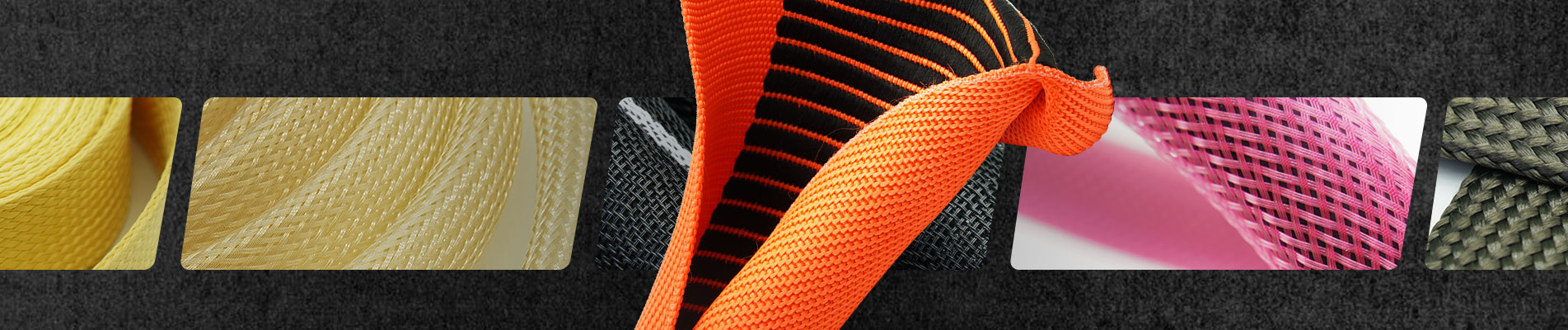
Automotive wire harnesses often need to pass through confined spaces, route around brackets, and operate in environments involving high temperatures, vibration, and friction. Selecting the right flame-retardant braided sleeving requires more than considering flame resistance. Installation location, operating temperature, harness diameter, abrasion protection requirements, and installation method should also be evaluated.
As a professional cable protection sleeving supplier, MJ FLEX offers various flame-retardant PET braided sleeving products to help customers select suitable protection based on the actual operating conditions of different automotive wire harnesses.
1. Select Based on Wire Harness Installation Location
Wire harnesses installed in different areas of a vehicle face different operating environments, resulting in different performance requirements for protective sleeving.
| Installation Location | Main Protection Requirements |
|---|---|
| Dashboard and interior areas | Flame retardancy, flexibility, noise control, and installation space |
| Engine compartment | Temperature resistance, abrasion resistance, vibration resistance, and compatibility with fluid exposure |
| Doors and moving components | Repeated bending, abrasion protection, and installation stability |
| Chassis and exposed areas | Abrasion resistance, moisture protection, and weather resistance |
| Electric vehicle power distribution areas | Flame retardancy, heat resistance, mechanical protection, and relevant electrical safety requirements |
When selecting sleeving, protection priorities should be determined according to the actual installation environment. Open-braid constructions should not be considered waterproof sealing materials or primary electrical insulation.
2. Understand Flame-Retardant Testing Standards
Flame-retardant performance is an important selection factor for automotive wire harness protective sleeving. However, different testing standards use different evaluation methods and have different scopes of application.
UL 94 evaluates the flammability of plastic materials. Common classifications include V-0, V-1, and V-2. Each classification corresponds to specified test conditions and does not directly represent the fire performance of a complete wire harness assembly.
VW-1 is one of the tests that may be used to evaluate the flame-retardant performance of sleeving. Its testing method differs from UL 94, and the two should not be considered equivalent.
FMVSS 302 primarily addresses the flammability of certain materials used in vehicle passenger compartments. Its applicability depends on the specific component and installation location.
For automotive wire harness projects, the appropriate flame-retardant classification should be selected according to OEM technical specifications and actual application requirements. Testing documentation for the specific product should also be verified.
3. Distinguish Flame Retardancy from Temperature Resistance
Flame retardancy and temperature resistance are two different technical properties.
Flame retardancy describes how a product behaves under specified flame-test conditions, while temperature resistance determines whether the sleeving can operate normally within a particular temperature environment.
Even when sleeving has flame-retardant properties, exposure beyond its applicable temperature range may cause softening, shrinkage, or deterioration of mechanical properties.
When selecting a product, consider the following:
Continuous operating temperature and minimum service temperature.
Short-term high-temperature exposure and its duration.
Distance from hot surfaces or heat sources.
Temperature fluctuations and long-term operating conditions.
Flame-retardant PET braided sleeving is suitable for various automotive wire harness protection applications. However, the specific temperature range should be confirmed according to the technical specifications of the selected product.
For high-temperature environments, select sleeving that meets the actual temperature requirements or provide additional thermal insulation protection.
4. Consider Abrasion Resistance and Braid Construction
Vibration generated during vehicle operation may cause wire harnesses to rub continuously against brackets, clips, panels, and adjacent components.
Therefore, abrasion resistance and braid construction are just as important as flame-retardant performance.
The following factors should be considered:
Monofilament material: Affects sleeving flexibility and mechanical protection performance.
Braid density: Influences surface coverage and protective performance.
Wall construction: Relates to the mechanical protection capability and flexibility of the sleeving.
Expansion behavior: Braid openings and coverage may change as the sleeving expands.
For wire harnesses exposed to continuous friction or vibration, the appropriate sleeving construction should be selected based on the actual contact locations.
5. Choose the Correct Size Based on Wire Harness Diameter
Correct sizing helps ensure convenient installation, adequate coverage, and effective protection.
Consider the actual outside diameter of the harness, including tape wrapping, connectors, and locally overlapping sections. For closed tubular sleeving, confirm whether the connectors can pass through the sleeve.
Although expandable braided sleeving accommodates a range of diameters, excessive expansion may loosen the braid construction and reduce surface coverage.
As expandable braided sleeving increases in diameter, its length may decrease accordingly. Therefore, cutting length should be determined according to the actual installed diameter and required coverage length.
For self-wrapping sleeving, sufficient overlap should be maintained after installation to prevent excessive openings when the wire harness bends.
6. Select the Appropriate Sleeving Construction
Different braided sleeving constructions are suitable for different wire harness assembly methods.
| Sleeving Type | Main Features | Suitable Applications |
|---|---|---|
| Expandable braided sleeving | Expandable, flexible, and adaptable to different harness diameters | Wire harnesses where the sleeve can be installed from an accessible end |
| Self-wrapping braided sleeving | Open construction allowing side installation | Wire harnesses with pre-installed connectors or requiring subsequent maintenance |
| Hook-and-loop or zippered sleeving | Reopenable closure for repeated access | Larger harnesses or areas requiring frequent inspection and maintenance |
Even when the same material is used, different sleeving constructions may exhibit different flame-retardant performance. Selection should therefore be based on the technical documentation of the specific product.
7. Consider the Actual Operating Environment
Automotive wire harnesses may be exposed to engine oil, fuel, coolant, cleaning agents, moisture, salt, or sunlight.
Different materials respond differently to these environmental factors. Selection should consider the actual substances involved, temperature, and operating conditions.
In addition, flame retardancy does not automatically mean low smoke emission, halogen-free composition, or compliance with specific chemical regulations.
If a project involves RoHS, REACH, halogen-free, or other requirements, the corresponding compliance documentation should be verified for the specific product.
8. Verify Installation Compatibility with Samples
Product specifications help with initial selection, while actual sample installation provides further confirmation of compatibility between the sleeving and the wire harness.
The following aspects should be checked:
Size and coverage: Whether the sleeving fits the harness properly and provides suitable coverage and overlap.
Installation convenience: Whether the sleeving is easy to install, cut, and finish at the ends.
Bending performance: Whether adequate flexibility is maintained in curved harness sections.
Securing performance: Whether the sleeving remains stable around clips, branches, and termination points.
Operating suitability: Whether the sleeving meets actual temperature, vibration, and friction requirements.
MJ FLEX can assist customers in selecting suitable sleeving sizes and provide samples for evaluation based on wire harness dimensions, operating environments, and installation requirements.
Common Selection Mistakes
When selecting flame-retardant braided sleeving for automotive wire harnesses, avoid the following common mistakes:
1. Focusing only on flame-retardant classification while ignoring operating temperature.
2. Treating different flame-retardant testing standards as equivalent.
3. Evaluating finished sleeving performance solely based on raw material properties.
4. Considering only the maximum expansion diameter while ignoring actual coverage.
5. Overlooking overlap and bending performance in self-wrapping sleeving.
6. Proceeding with bulk purchasing without verifying actual installation performance.
Proper selection should consider flame-retardant performance, temperature range, mechanical protection capability, and installation compatibility together.
Frequently Asked Questions (FAQ)
No. Flame-retardant braided sleeving demonstrates a specified level of flame resistance under particular testing conditions. It does not mean the product can withstand unlimited temperatures or prolonged direct flame exposure.
Not necessarily. UL 94 V-0 is a flame-retardant classification. Actual suitability must also be evaluated according to OEM requirements, installation location, operating temperature, and other performance conditions.
It can be considered depending on the actual operating conditions. If the product meets the required temperature range, flame-retardant performance, and mechanical properties, it may be suitable for engine compartment wire harness protection. Additional thermal protection requirements should be evaluated near high-temperature areas such as exhaust systems.
Expandable braided sleeving is suitable for harnesses that allow installation from an accessible end, while self-wrapping sleeving is appropriate for harnesses with pre-installed connectors or those requiring side installation. The final choice should depend on the installation method and protection requirements.
MJ FLEX offers flame-retardant expandable PET braided sleeving and self-wrapping PET braided sleeving, combining flexibility, abrasion resistance, and installation convenience to meet the protection needs of different automotive wire harnesses.
We support a variety of sizes and product options and can provide relevant technical documentation and samples based on customers' actual application requirements.
Contact MJ FLEX with your wire harness diameter, installation location, operating temperature, flame-retardant requirements, and purchase quantity. We will help you select suitable braided sleeving and provide a quotation.